Hide
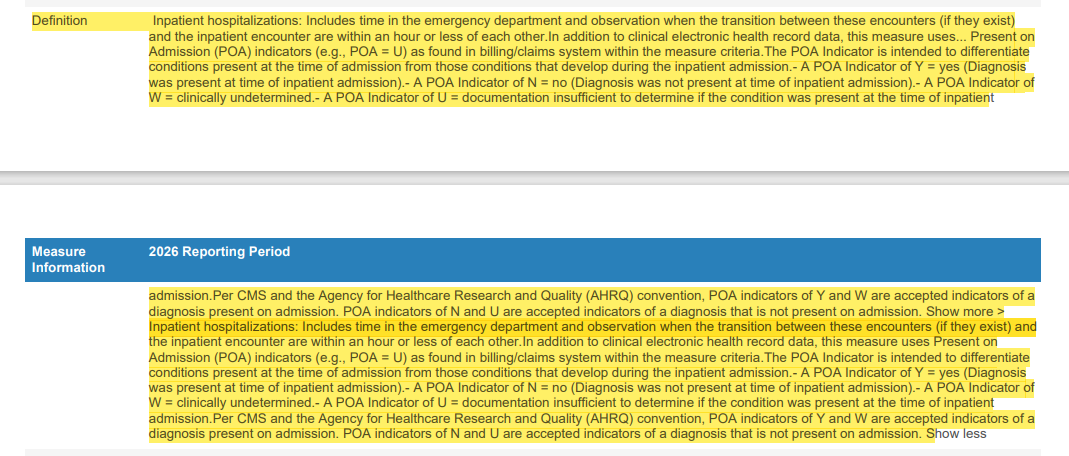
Thank you for your question regarding CMS826v3, Hospital Harm - Pressure Injury. The inpatient hospitalization period assessed by this measure includes time in the emergency department (ED) and observation when the transition between discharge from these encounters and admission to the inpatient encounter is one hour or less, regardless of how much time the patient spends in the ED encounter and/or observation status. Because the scenarios described in this inquiry do not specify the end date/time(s) of the ED encounter or observation status, we are not able to make a determination of when the inpatient hospitalization period would begin for these scenarios. However, if the transition between discharge from the ED encounter and/or observation status and the admission to the inpatient encounter is one hour or less, then the inpatient hospitalization period begins with the start of the ED encounter and/or observation status. If the transition between discharge from the ED encounter and/or observation status and admission to the inpatient encounter is greater than one hour, then the inpatient hospitalization period assessed by this measure starts at the inpatient admission.
This eCQM assesses patient data from the patient's entire hospitalization period. So, if a Present on Admission (POA) indicator of "Y" or "W" is assigned for a deep tissue pressure injury (DTPI) or a stage 2, 3, 4, or unstageable pressure injury diagnosis, the inpatient hospitalization for that patient will meet the denominator exclusions criteria, regardless of when the POA indicator status was updated by the hospital.
Show
Thank you for your question regarding CMS826v3, Hospital Harm - Pressure Injury. The inpatient hospitalization period assessed by this measure includes time in the emergency department (ED) and observation when the transition between discharge from these encounters and admission to the inpatient encounter is one hour or less, regardless of how much time the patient spends in the ED encounter and/or observation status. Because the scenarios described in this inquiry do not specify the end date/time(s) of the ED encounter or observation status, we are not able to make a determination of when the inpatient hospitalization period would begin for these scenarios. However, if the transition between discharge from the ED encounter and/or observation status and the admission to the inpatient encounter is one hour or less, then the inpatient hospitalization period begins with the start of the ED encounter and/or observation status. If the transition between discharge from the ED encounter and/or observation status and admission to the inpatient encounter is greater than one hour, then the inpatient hospitalization period assessed by this measure starts at the inpatient admission.
This eCQM assesses patient data from the patient's entire hospitalization period. So, if a Present on Admission (POA) indicator of "Y" or "W" is assigned for a deep tissue pressure injury (DTPI) or a stage 2, 3, 4, or unstageable pressure injury diagnosis, the inpatient hospitalization for that patient will meet the denominator exclusions criteria, regardless of when the POA indicator status was updated by the hospital.
Hosp Inpt eCQMs - Hospital Inpatient eCQMs
 Critical