Determining calculated gestational age by the last entered estimated delivery date

XMLWordPrintable

    • Type: Hosp Inpt eCQMs - Hospital Inpatient eCQMs
    • Resolution: Answered
    • Priority: High
    • Component/s: None
    • None
    • Hide
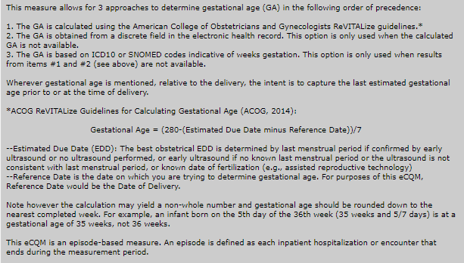
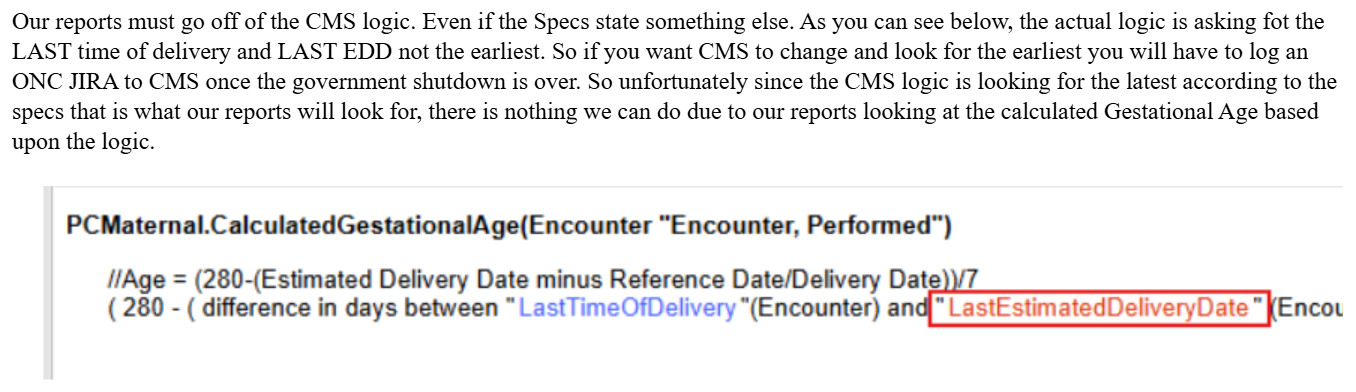
      Thank you for your question about CMS334/PC-02 Cesarean Birth and CMS1028/PC-07 Severe Obstetric Complications. The logic looks for the last, or most recent, assessed EDD that would be used to calculate the gestational age. While later ultrasound readings may document additional EDDs in the record, clinicians determine which is the best obstetrical Estimated Due Date that is alluded to in the Guidance section of the human readable.

      The guidance may seem to be incongruent with the logic, but clinical practice must drive technology - not the other way around. The logic looks for the assessment performed to determine the EDD, a method described in the Guidance section which may be updated at later date/times by the clinician and takes the most recent assessed EDD to calculate the gestational age. The later EDDs determined by ultrasound as the pregnancy progresses are not the same, and how this is distinguished within different EHR platforms varies. Therefore, we recommend that you work with your EHR vendor to make sure the report pulls the correct data from the most appropriate fields.
      Show
      Thank you for your question about CMS334/PC-02 Cesarean Birth and CMS1028/PC-07 Severe Obstetric Complications. The logic looks for the last, or most recent, assessed EDD that would be used to calculate the gestational age. While later ultrasound readings may document additional EDDs in the record, clinicians determine which is the best obstetrical Estimated Due Date that is alluded to in the Guidance section of the human readable. The guidance may seem to be incongruent with the logic, but clinical practice must drive technology - not the other way around. The logic looks for the assessment performed to determine the EDD, a method described in the Guidance section which may be updated at later date/times by the clinician and takes the most recent assessed EDD to calculate the gestational age. The later EDDs determined by ultrasound as the pregnancy progresses are not the same, and how this is distinguished within different EHR platforms varies. Therefore, we recommend that you work with your EHR vendor to make sure the report pulls the correct data from the most appropriate fields.
    • CMS0334v6, CMS1028v3
    • Hide
      By pulling the most recent EDD to calculate the EGA at delivery and not one calculated earlier in pregnancy, the report is finding some patients to be preterm who weren't actually preterm or vice versa. This is most notably disruptive on PC-02, where patients are included in the denominator only if they are term. We have also seen it affect outcomes on PC-07 where the pregnancy ended near 20 weeks gestation, which is the cut off for that measure. Since most pregnancies have an ultrasound later in pregnancy, the calculated EGA at delivery is often off from what the last charted EGA/clinically used EGA was.
      Show
      By pulling the most recent EDD to calculate the EGA at delivery and not one calculated earlier in pregnancy, the report is finding some patients to be preterm who weren't actually preterm or vice versa. This is most notably disruptive on PC-02, where patients are included in the denominator only if they are term. We have also seen it affect outcomes on PC-07 where the pregnancy ended near 20 weeks gestation, which is the cut off for that measure. Since most pregnancies have an ultrasound later in pregnancy, the calculated EGA at delivery is often off from what the last charted EGA/clinically used EGA was.

      Previously our EDD wasn't pulling in and we were basing our gestational age at delivery by the 2nd method, by last EGA at delivery, which worked well enough. We recently took a new package from our vendor, and now the most recently documented EDD is pulling into the chart and calculating the gestational age at delivery.  The trouble is, it's taking the most recent EDD, which is often not the most accurate EDD.  The specs state that EDD should be determined by LMP and/or early ultrasound, which is how we practice clinically.  However, every time the patient gets an ultrasound a new EDD is created in her electronic chart based on that ultrasound. In our EHR (Cerner) the pregnancy's EGA is always calculated off of the "authoritative" EDD. So all the EDDs from any ultrasounds and the LMP will be visible, but one is marked as "authoritative" and that's the official one. This is done by the provider per ACOG guidance on LMP and early ultrasound. Our vendor is saying that per the CMS logic, they have to take the "last" EDD, or the most recently generated EDD, not the "authoritative" EDD. So if the patient had a 20-week anatomy ultrasound, which most of them do, or an ultrasound even further along in the pregnancy, it's pulling that EDD, not the EDD from early in the pregnancy or from the LMP. It's not uncommon for the EDD to be off enough to bump the pregnancy along or behind a week or even 2 from what the early ultrasound EDD was. This is clearly contrary to the guidance in the specs, but the logic trumps the specs and the vendor says they are pulling the EDD correctly and there is nothing they can do to change it. Is this a correct interpretation of the logic?
            Assignee:
            Mathematica EH eCQM Team
            Reporter:
            Jennifer Harlos
            Votes:
            6 Vote for this issue
            Watchers:
            13 Start watching this issue

              Created:
              Updated:
              Resolved:
              Solution Posted On: