Measure Observation 1

XMLWordPrintable

    • Type: Hosp Inpt eCQMs - Hospital Inpatient eCQMs
    • Resolution: Answered
    • Priority: Moderate
    • Component/s: None
    • None
    • Hide
      Thank you for your question regarding CMS871v4, Hospital Harm - Severe Hyperglycemia. This measure assesses the number of inpatient hospital days for patients age 18 and older with a hyperglycemic event (harm) per the total qualifying inpatient hospital days for that encounter. As this is a ratio measure, the measure includes two measure observations that assess the inpatient hospitalizations identified through the numerator and denominator criteria to return the inpatient hospital days that are ultimately used in the measure calculation.

      To calculate the ratio of inpatient hospital days, the denominator and numerator first identify the inpatient hospitalizations to be assessed by the measure. The denominator identifies inpatient hospitalizations for patients age 18 and older that end during the measurement period and that (1) have a diagnosis of diabetes that starts before the end of the encounter; (2) administration of at least one dose of insulin or hypoglycemic medication that starts during the encounter; or (3) presence of at least one glucose value >=200 mg/dL at any time during the encounter. The numerator identifies inpatient hospitalizations with a hyperglycemic event within the first 10 days of the encounter minus the first 24 hours, and minus the last period before discharge from the hospital if less than 24 hours. The measure defines a day with a hyperglycemic event as a day with at least one glucose value >300 mg/dL, OR a day where a glucose test and result was not found, and it was immediately preceded by two consecutive days where at least one glucose value during each of the two days was >=200 mg/dL.

      Measure observation 1, associated with the denominator, returns the total number of eligible hospital days of inpatient hospitalizations that meet the denominator criteria and do not meet the denominator exclusion criteria. Measure observation 2, associated with the numerator, returns the total number of hyperglycemic event days during inpatient hospitalizations that meet the numerator criteria and do not meet the numerator exclusion criteria. The two measure observations are then used to calculate the ratio of the number of inpatient hospital days with a hyperglycemic (high blood glucose) event over the total number of eligible inpatient hospital days (<= 10 days) for that encounter.

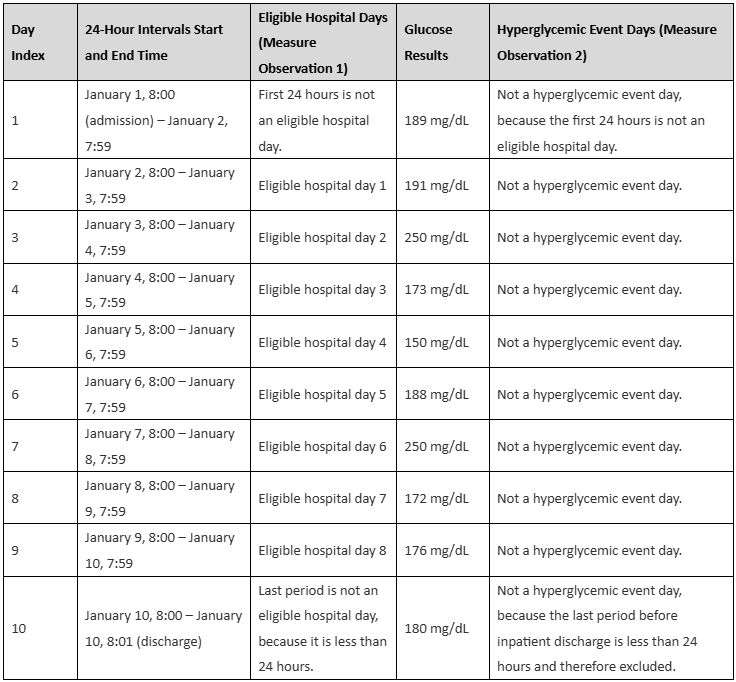
      In the scenario you provide, because the patient has at least one day with a glucose of >=200 mg/dL, the inpatient hospitalization for the patient meets the measure’s denominator criteria. As outlined by the table below, measure observation 1 would return eight (8) eligible hospital days for the inpatient hospitalization, as the hospitalization meets the denominator criteria. However, during the inpatient hospitalization, the patient does not experience any days with a hyperglycemic event, as there are no days during the hospitalization with glucose results >300 mg/dL and no days without glucose results that are preceded by two consecutive days with daily results of >= 200 mg/dL. This means that the inpatient hospitalization does not meet the numerator criteria, and measure observation 2 would return 0 hyperglycemic event days. Therefore, the measure ratio for this inpatient hospitalization would be calculated as [0 (Measure Observations 2)/8 (Measure Observations 1) = 0]. And as this measure is an inverse measure, a lower measure score indicates higher quality of care.

       (A reference table has also been attached to this ticket as part of this response.)
      Show
      Thank you for your question regarding CMS871v4, Hospital Harm - Severe Hyperglycemia. This measure assesses the number of inpatient hospital days for patients age 18 and older with a hyperglycemic event (harm) per the total qualifying inpatient hospital days for that encounter. As this is a ratio measure, the measure includes two measure observations that assess the inpatient hospitalizations identified through the numerator and denominator criteria to return the inpatient hospital days that are ultimately used in the measure calculation. To calculate the ratio of inpatient hospital days, the denominator and numerator first identify the inpatient hospitalizations to be assessed by the measure. The denominator identifies inpatient hospitalizations for patients age 18 and older that end during the measurement period and that (1) have a diagnosis of diabetes that starts before the end of the encounter; (2) administration of at least one dose of insulin or hypoglycemic medication that starts during the encounter; or (3) presence of at least one glucose value >=200 mg/dL at any time during the encounter. The numerator identifies inpatient hospitalizations with a hyperglycemic event within the first 10 days of the encounter minus the first 24 hours, and minus the last period before discharge from the hospital if less than 24 hours. The measure defines a day with a hyperglycemic event as a day with at least one glucose value >300 mg/dL, OR a day where a glucose test and result was not found, and it was immediately preceded by two consecutive days where at least one glucose value during each of the two days was >=200 mg/dL. Measure observation 1, associated with the denominator, returns the total number of eligible hospital days of inpatient hospitalizations that meet the denominator criteria and do not meet the denominator exclusion criteria. Measure observation 2, associated with the numerator, returns the total number of hyperglycemic event days during inpatient hospitalizations that meet the numerator criteria and do not meet the numerator exclusion criteria. The two measure observations are then used to calculate the ratio of the number of inpatient hospital days with a hyperglycemic (high blood glucose) event over the total number of eligible inpatient hospital days (<= 10 days) for that encounter. In the scenario you provide, because the patient has at least one day with a glucose of >=200 mg/dL, the inpatient hospitalization for the patient meets the measure’s denominator criteria. As outlined by the table below, measure observation 1 would return eight (8) eligible hospital days for the inpatient hospitalization, as the hospitalization meets the denominator criteria. However, during the inpatient hospitalization, the patient does not experience any days with a hyperglycemic event, as there are no days during the hospitalization with glucose results >300 mg/dL and no days without glucose results that are preceded by two consecutive days with daily results of >= 200 mg/dL. This means that the inpatient hospitalization does not meet the numerator criteria, and measure observation 2 would return 0 hyperglycemic event days. Therefore, the measure ratio for this inpatient hospitalization would be calculated as [0 (Measure Observations 2)/8 (Measure Observations 1) = 0]. And as this measure is an inverse measure, a lower measure score indicates higher quality of care.  (A reference table has also been attached to this ticket as part of this response.)
    • CMS0871v4
    • Validating how to calculate Measure Observation 1

      Question for what how to determine Measure Observation 1 that is associated with the denominator of the ratio. The total number of eligible days of the inpatient hospitalization which match the initial population/denominator criteria and did not meet the denominator exclusion criteria.

      Patient was a direct IP admit on 1/1/25 at 0800. Discharged on 1/10/25 at 0801. There are no denominator exclusions.

      Do we look to see if there was at least one glucose >=200 mg/dL during the time frame of 1/2/25 0800 to 1/3/25 @ 0759 and then from 1/3/25 0800 to 1/4/25 @ 0759 and so on for each day until discharge (Up to day 10 days unless DC day is less than 24 hours)  to see if the time frames during these 24 hours include a glucose >=200 to give us a Denominator observation day?

      For example, if all the time frames from the 0800 to 0759 on each eligible day included several glucoses < 200 but 2 of the days included a glucose of 250 would Measure Observation 1 have a count of 2?
       

            Assignee:
            Mathematica EH eCQM Team
            Reporter:
            Diane
            Votes:
            0 Vote for this issue
            Watchers:
            3 Start watching this issue

              Created:
              Updated:
              Resolved:
              Solution Posted On: